Blog
What a support worker notices
The Aldera team Published 17 September 2026
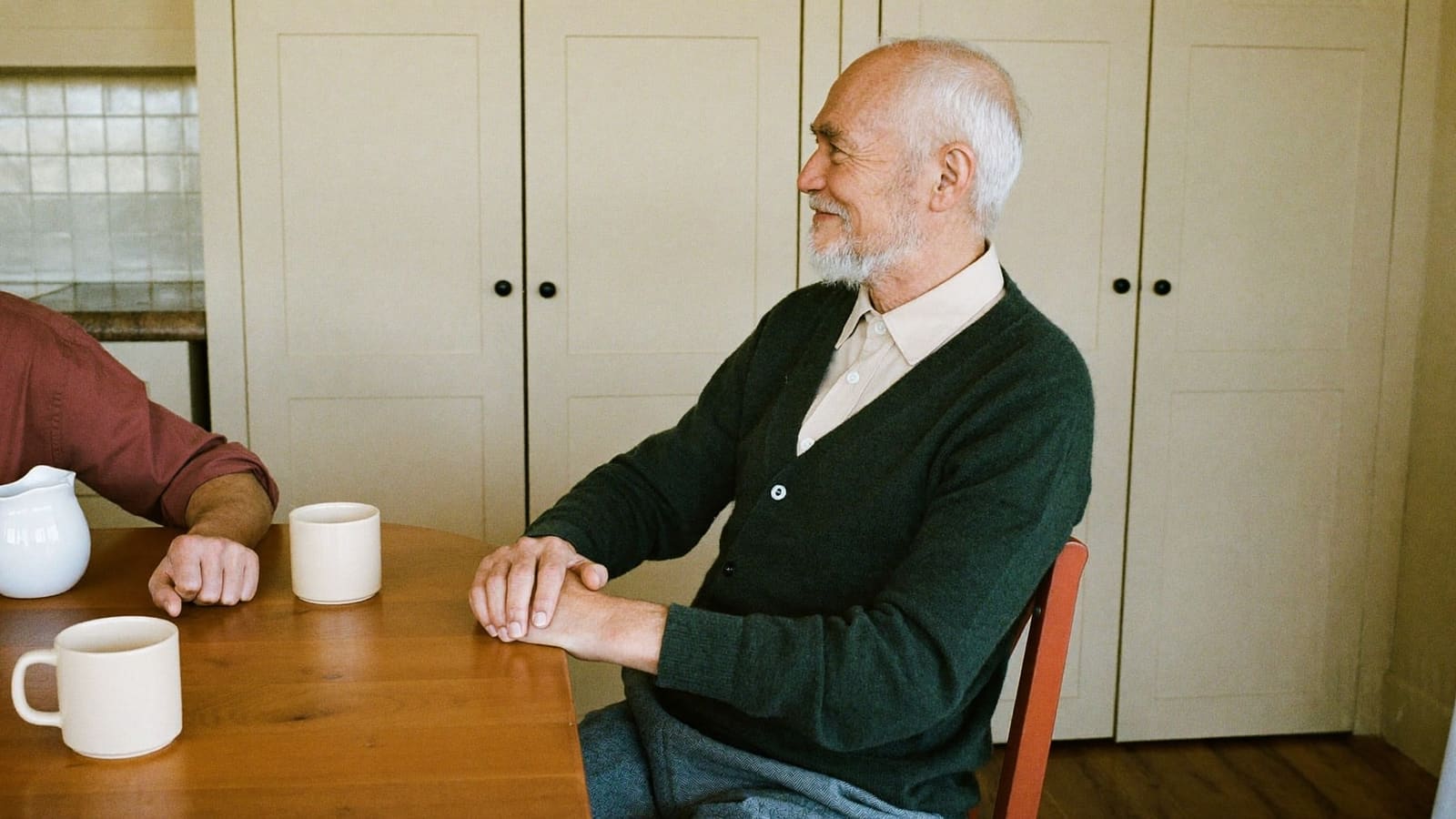
Illustrative. Does not depict Aldera clients or staff.
A geriatrician gets twenty minutes, twice a year, in a consulting room, with someone who has put on a good shirt and rehearsed the answer to “how have you been?”
A support worker gets two hours, every Tuesday, in the actual kitchen.
That is not a criticism of specialists. It is a description of two completely different vantage points, and the second one sees a category of thing the first one structurally cannot.
The things that never make it to an appointment
None of these are dramatic. That is the point.
The wheelie bin did not go out, for the second week. There is more food in the fridge than there was last Tuesday, which means less of it is being eaten. The same jumper is on two visits running. A walk down the hall that used to be automatic now involves a hand on the wall. The mail has not been brought in. A name that was there last month has gone.
There is a new bruise on a shin, in a spot that suggests the coffee table. The kettle is being filled to the top and carried, when it used to be filled halfway. Somebody who talked about the bowls club every week has stopped mentioning it.
Not one of those would come up in an appointment. Several of them are the first visible sign of something worth acting on, whether that is an infection, a new pain being quietly tolerated, a medication that has stopped being taken, or a mood that has gone somewhere flat.
Why it only works if it is the same person
Noticing is comparison. A change is only a change against a baseline, and a stranger has no baseline.
Send a different worker every week and each of them sees a snapshot. A man in the same jumper is just a man in a jumper. A fridge with food in it is a fridge with food in it. Every one of those visits can be perfectly competent and the pattern still goes unseen, because there is nobody holding the before.
This is the real cost of churn, and it is not mainly about the awkwardness of a new face in the bathroom. It is that the instrument keeps getting reset. We wrote about that in the hidden cost of carer churn in home care, and it is the reason a small Care Circle is the whole design rather than a nice extra.
Noticing is only half of it
A worker who sees something and tells nobody has not achieved anything. Neither has a worker who tells one person who then leaves.
So the second half is that the observation goes somewhere. In our case it goes into the One Story record, which is the thing the whole Care Circle reads, and where it warrants action it goes to the Care Lead, who decides whether it is a note for next week or a phone call this afternoon.
That is the difference between a system and a good individual. Good individuals leave, take holidays and get rostered elsewhere. When your regular support worker leaves is about doing that handover properly, and it only works because the knowledge was written down while they were still there.
The line between noticing and hovering
There is a version of this that people are right to dislike. Being observed, catalogued and discussed by the people who come to your house is not care, and treating an adult as a set of indicators is a way of making them smaller.
The rule that keeps it on the right side is simple and it is not negotiable: anything worth writing down is worth saying out loud, to the person it is about, in the room, at the time.
“I noticed the bin is still out the front, do you want me to bring it round?” is a conversation. Writing it in a file and telling the daughter is not.
That also tends to produce better information. Asked directly, people usually explain. The bin did not go out because the wheel is broken. The jumper is on again because the washing machine is playing up. Half the things that look like decline turn out to be an ordinary problem with an ordinary fix, and the only way to find that out is to ask the person rather than the file.
What families can do with this
If you live a long way away, this is the most useful thing you have. Someone is in that kitchen every week. Ask them what they see, agree with your parent what gets passed on, and then actually listen to the small stuff rather than waiting for something big. Caring for a parent from a long way away goes further into that.
And if a worker tells you something that sounds minor, take it seriously. They are not reporting the bin. They are reporting that something changed, and the bin is just the part that is visible from the street.
Part of our The Aldera way guide.
Not sure where you fit?
Call us and a real person will talk it through, no obligation and no script.
Call 1300 998 928Common questions
Should a support worker be reporting things back to my family?
Only what you have agreed to. Some people want their daughter told about everything, some want the practical things passed on and the private ones kept private, and both are reasonable. What matters is that the arrangement is your decision, written down, and the same every week rather than depending on who is rostered.
What happens when a worker notices something?
It should go somewhere other than that worker's memory. In our case it goes into the One Story record and, where it needs action, to the Care Lead, who decides whether it is a note for next week or a phone call today. A concern that only exists in one person's head disappears the week they take leave.
Is it intrusive to have someone watching for changes?
It can be, if it is done badly. Noticing is not surveillance, and the difference is whether the person is told. Anything worth writing down is worth mentioning to the person it is about, in the room, at the time. That is a rule rather than a courtesy.
More blog
-
Blog
Grandchildren and a grandparent's care
Grandchildren often want to help when a grandparent starts needing care but do not know how. Practical ways for younger family to stay close and useful.
15 October 2026
-
Blog
Staying at home after losing a partner
When a husband or wife dies, the house changes overnight. Some gentle, practical thoughts on grief, routine and getting the right help at home.
7 October 2026
-
Blog
When your husband or wife becomes your carer
Caring for a partner is not like caring for a parent. Staying a couple, accepting help without feeling you have failed, and looking after yourself.
5 October 2026