Guides
Stairlifts and getting between floors
The Aldera team Published 2 September 2026
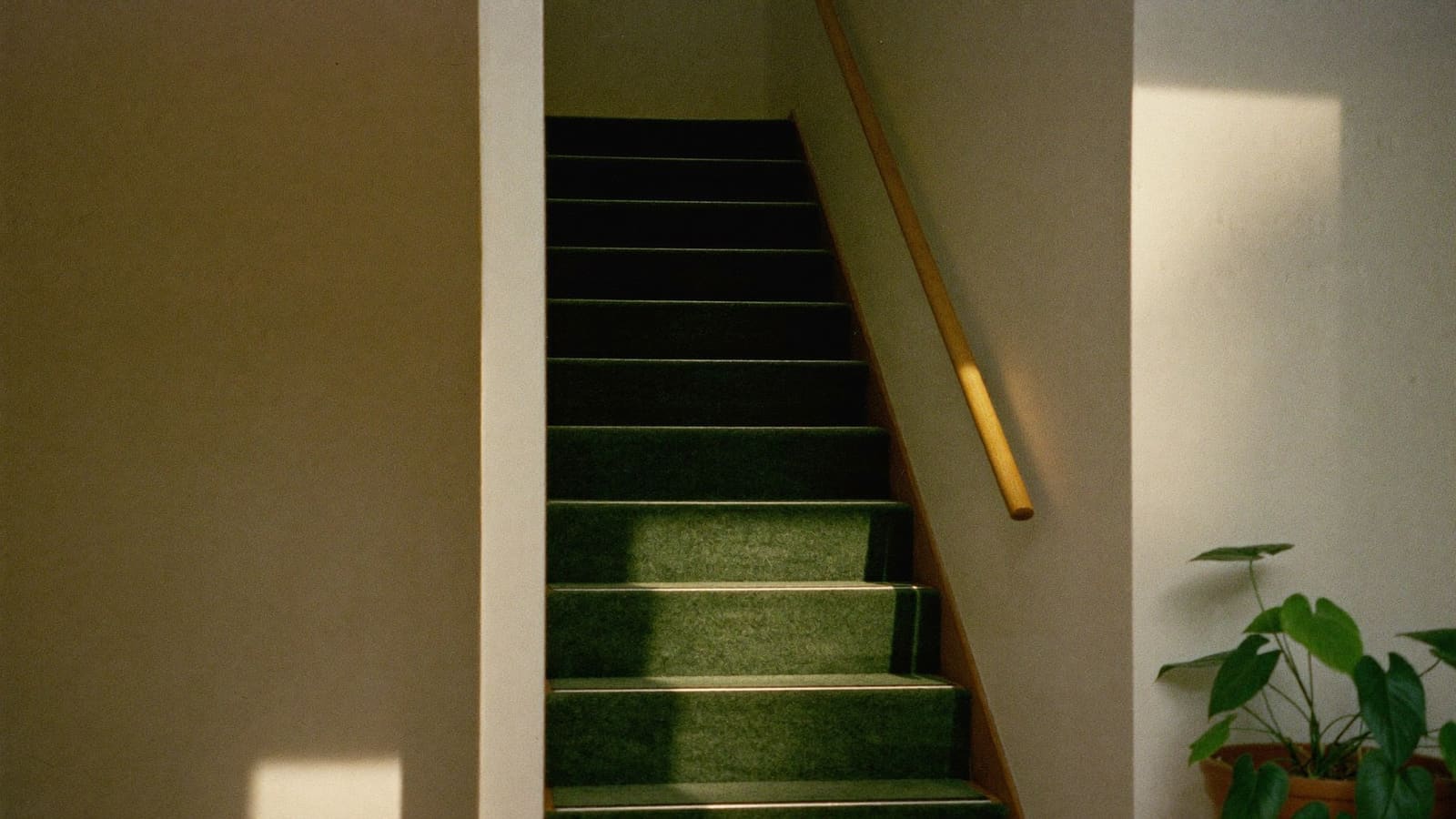
Illustrative. Does not depict Aldera clients or staff.
A staircase is the single most decisive feature of a two-storey house as people age. It determines whether someone uses half their home or all of it, and whether the bathroom is reachable at three in the morning.
A stairlift is the answer people think of first. It is sometimes right and it is frequently not the best option, so it is worth working through the alternatives before committing to a major installation.
This is general information, not advice. Whether someone can safely use stairs, or a stairlift, is a clinical judgement for an occupational therapist or physiotherapist.
Try living on one level first
This is the option most people skip and it is often the better answer.
Moving the bedroom to the ground floor, and getting at least a toilet and ideally a shower onto that level, removes the problem rather than equipping it. It is usually cheaper than a stairlift, it is quicker, and it does not depend on a mechanism that can fail.
The objection is almost always emotional rather than practical: the bedroom has been upstairs for forty years and moving it feels like a defeat. That is a real feeling and worth naming, but a downstairs bedroom that gets used beats an upstairs one reached by a machine.
Where it does not work is a house with no space downstairs and no plumbing to work with. Then the stairs have to be solved.
The cheap things that sometimes solve it
Before a lift, check whether the stairs themselves are the problem or just badly set up.
- A second handrail, on the other side. Two rails is a completely different staircase from one
- Rails that extend past the top and bottom step, which is where people let go and fall
- Contrast on the step edges, so the treads can be seen
- Lighting with a switch at both ends, and a sensor light for night
- Replacing worn or loose carpet, and removing anything at the top or bottom of the flight
- A chair or landing halfway, if there is a turn, so the climb can be broken
For plenty of people, two rails and proper lighting is the whole intervention. Our home safety checklist walks the rest of the house on the same logic.
When a stairlift is the right call
When someone can transfer on and off a seat safely, has the cognition to operate it consistently, and the house genuinely cannot be lived in on one level.
That first condition is the one that gets missed. A stairlift does not help a person who cannot safely sit down and stand up at each end, and it can introduce a new fall risk at the top of a flight. This is why the clinical assessment is not a formality.
What to check before you buy one
Get an occupational therapist to assess the actual staircase and the actual person. Not a supplier’s measure-up. The OT is assessing whether this person can use this device safely, which is a different question from whether it fits.
Straight or curved. Straight flights are simpler and cheaper. Curved staircases need a custom rail, cost substantially more, and take longer to make.
Width and obstructions. Whether the flight is wide enough with a rail fitted, whether a door at the bottom still opens, and whether the landing gives room to get off safely.
How it parks. Whether the seat folds clear so other people can still use the stairs, and where the carriage sits when not in use.
Power and battery. Whether it runs in a blackout, which matters if someone would otherwise be stranded upstairs.
Safety features. Seatbelt, obstruction sensors, and whether the controls suit arthritic hands.
Servicing and repairs. Who services it, how often, what it costs, and the response time for a breakdown. Ask this before you buy, because a stairlift that is out of service for a fortnight is a household with no upstairs.
Removal and resale. What it costs to take out, and whether the installation is reversible if the house is rented or sold.
Other lift options
A through-floor lift replaces the stairs entirely with a small enclosed platform between floors. It suits someone who cannot transfer onto a stairlift seat or who uses a wheelchair. It costs considerably more, needs structural work and takes floor space on both levels.
A platform lift is generally for external steps rather than internal stairs, and is worth knowing about if the real problem is getting in the front door rather than getting upstairs.
How it gets paid for
A stairlift is a major home modification, so it sits on the assistive technology and home modifications side of Support at Home rather than coming out of the budget that pays for your visits. That distinction is explained in what the AT-HM scheme pays for, and the broader sequencing is in home modifications for ageing in place.
Expect it to take time: an assessment, a clinical recommendation, quotes, an approval and then a manufacturing and installation lead time. That is a good reason to do the cheap safety work on the stairs immediately rather than waiting, because the flight stays exactly as dangerous as it is until something changes.
For eligibility and current scheme detail start at myagedcare.gov.au. If you want a second opinion on whether a house can be lived in on one level, ring us and a person will answer.
Part of our How funding works guide.
Not sure where you fit?
Call us and a real person will talk it through, no obligation and no script.
Call 1300 998 928Common questions
What are the alternatives to a stairlift?
Living on one level is the most common and often the best, by moving the bedroom downstairs and putting a bathroom or at least a toilet on that floor. Other options are a second handrail and better lighting where the stairs are still manageable, a through-floor lift where a stairlift will not fit, and in some homes a platform lift outside for entry steps rather than internal stairs.
Will a stairlift fit any staircase?
Not always. Straight flights are straightforward and relatively affordable. Curved or turning staircases need a custom rail, which costs considerably more and takes longer. Narrow flights, a door at the bottom or a tight landing can all rule one out, which is why an on-site assessment comes before any decision.
Is a stairlift covered by aged care funding?
It can be, as a major home modification under the assistive technology and home modifications side of Support at Home, and it will need a clinician's assessment behind it. Tiers, limits and rules are set nationally and change, so confirm your own position with My Aged Care or your provider rather than assuming either way.
More guides
-
Guides
Drinking enough water in later life
Why older people drink less without noticing, the signs of dehydration to watch for, and small habits that make drinking easier at home.
15 October 2026
-
Guides
Recognising elder abuse and where to get help
The forms elder abuse takes, the quiet signs families and workers notice, and who to contact in NSW if you are worried about an older person.
15 October 2026
-

Guides
Talking to a parent about giving up driving
Signs driving is getting harder, how to raise it without a fight, who can give an independent view, and how to keep a parent getting out once the keys go.
15 October 2026