Guides
Keeping on top of medications at home
The Aldera team Published 17 September 2026
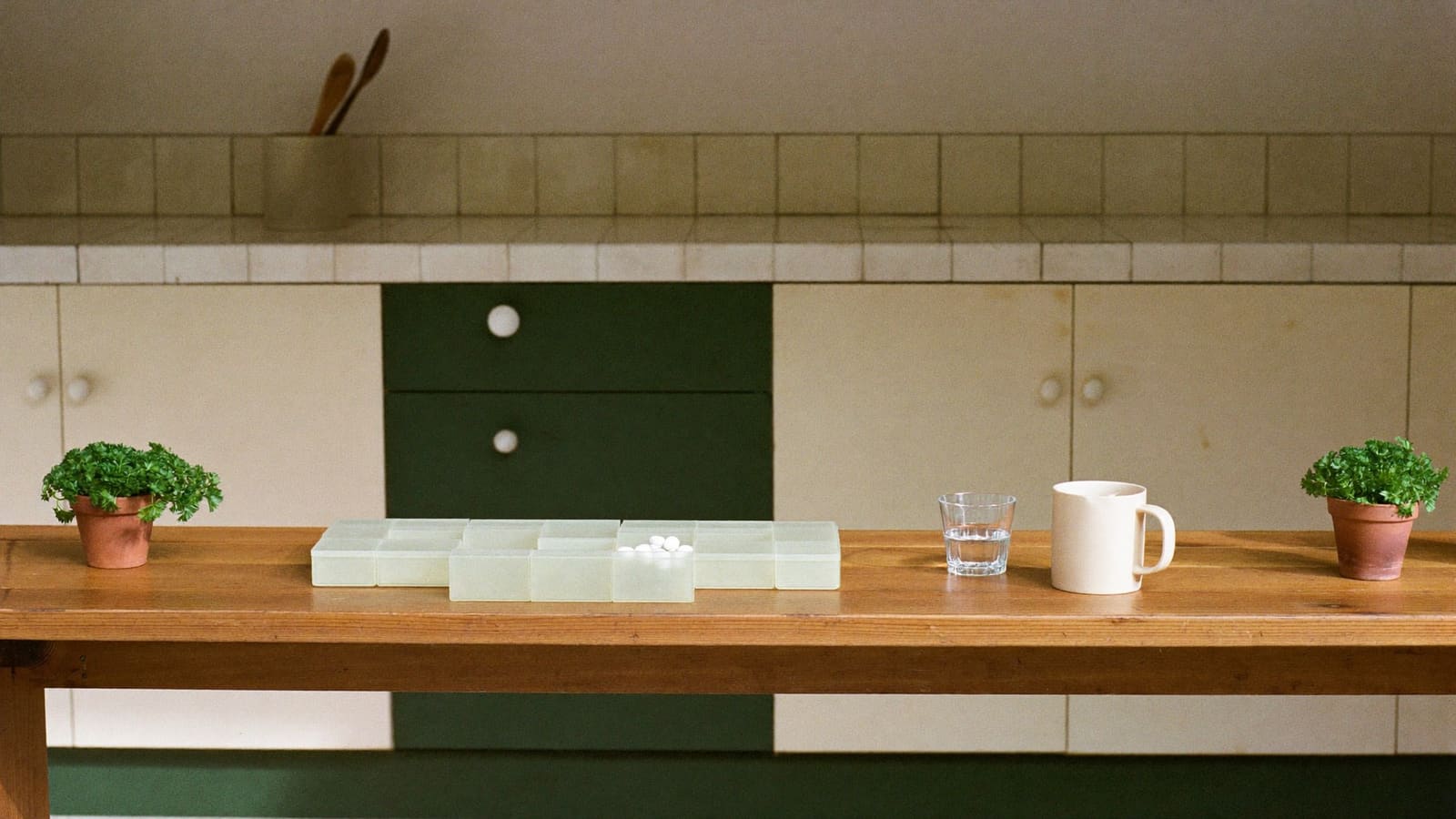
Illustrative. Does not depict Aldera clients or staff.
Nobody sets out to take eleven different things a day. It accumulates. A GP adds one, a specialist adds another, something goes on after a hospital stay and never comes off, and one morning the kitchen bench has more packets on it than plates.
This guide is general information, not clinical advice. Nothing here is a reason to change, stop or start anything. That conversation belongs with your GP and your pharmacist.
The problem is rarely forgetfulness
It is worth saying plainly, because families often land on the wrong fix.
When medications go wrong at home, the usual causes are a changed routine, a packet that is genuinely too hard to open, two boxes that look almost identical, a dose that was changed at the hospital and never updated on the list at home, or a day that simply ran differently from the others. Very little of that is memory.
Which matters, because the response to a memory problem is a reminder, and the response to a system problem is a better system. Reminders bolted onto a bad system just make a person feel watched.
Build the routine around something that already happens
The habits that survive are the ones attached to an existing anchor. The kettle in the morning. The news at six. Sitting down to lunch. A fixed time of day works far less well than a fixed event, because events happen whether or not anyone looked at a clock.
Then keep the medicines where that event happens. A pack in the bathroom cabinet and a morning routine in the kitchen is two rooms of friction every single day.
What actually helps
- One list, kept current, kept where people can find it. Name, dose, when, and what it is for. The last column is the one everyone leaves off and the one that makes the list useful to a locum, a paramedic or a hospital. Keep it with the emergency information sheet rather than in a drawer.
- A dose aid, if the pharmacist agrees it suits. A weekly organiser filled once, or a pharmacy-packed sheet. It converts a daily decision into a weekly one, and it makes a missed dose visible instead of invisible.
- One pharmacy. Splitting scripts across three shops means nobody is holding the whole picture, and the whole picture is what catches an interaction.
- Fix the packaging, not the person. Blister packs and child-resistant lids defeat arthritic hands routinely. A pharmacist can often supply easier packaging on request, and a tablet that cannot be got out of the foil is a tablet that is not being taken.
- Water, within reach. A surprising number of missed doses are really a missed glass of water. If swallowing has become effortful or tablets catch, that is worth raising rather than crushing anything, because some tablets must not be crushed. Speech pathology, swallowing and speaking covers what can be done about it.
- A plan for the ones taken “as needed”. Pain relief and puffers are the most commonly muddled, because there is no fixed time to hang them on. Write down what triggers a dose and what the ceiling is for the day.
The moments when mistakes cluster
Three, and all three are transitions.
Coming home from hospital. The list is almost always different from the one that went in, sometimes substantially, and the version at home is now wrong. Reconcile the two before the first dose, not in week three. Coming home from hospital covers the rest of that fortnight.
A specialist visit. A dose gets changed in a consulting room and the household list does not hear about it. Take the list in and bring it out updated. That is part of what to carry to any appointment, set out in what to take to a GP appointment.
A new person in the house. A fill-in worker, a family member covering a week, a hospital stay for the carer rather than the client. Everything held in one person’s head is at risk the moment that person is not there.
Who does what
A GP prescribes, changes and stops. A pharmacist dispenses, packs, advises on interactions and can review the whole list at home. A nurse administers where administering is required.
A support worker prompts and enables. They can bring the pack over, open what is stiff, pour the water, stay while it is taken and record that it was. Where the line sits between prompting and administering should be stated in your agreement, not assumed, and our personal care page says how we describe it.
When the list itself is the problem
If the list has grown past what anyone can explain, the answer is not a better pill box. It is a proper review of whether every item still earns its place, which is exactly what a Home Medicines Review is for. A pharmacist sits at the kitchen table, goes through the lot, and writes to the GP.
Long lists are not a personal failing. They are what happens when care is delivered by several people over many years and nobody is asked to look at the whole.
Where consistency earns its keep
Medication safety is mostly pattern recognition, and a pattern needs somebody who was there last week.
At Aldera the routine, the packaging, the anchors and the things that have gone wrong before sit in the One Story record rather than in one worker’s memory, and the same small Care Circle comes back, so a dose that has started being skipped registers as a change.
For what is funded and how it is arranged, start at myagedcare.gov.au and raise medication support specifically at your assessment.
Part of our Our services guide.
Not sure where you fit?
Call us and a real person will talk it through, no obligation and no script.
Call 1300 998 928Common questions
Can a support worker give me my tablets?
A support worker can prompt and remind you, bring you the pack and the water, open what you cannot open, and check with you that it has been taken. Administering medication is a clinical task with its own rules and training, so it sits elsewhere. The important thing is that your provider tells you plainly which of those two things they are doing, and that it is written into your plan rather than left to whoever turns up.
Should we get a Webster pack?
A pharmacy-packed dose aid suits a lot of people and removes the daily sorting, but it is not automatically right. It can make a change mid-month awkward, it does not hold everything, and some people manage better with the original boxes. Ask your pharmacist what it would and would not cover in your case, because they are the ones who would pack it.
Who should review all of the medicines together?
Your GP holds the prescribing picture, and a pharmacist can be asked to review everything in one go at home through a Home Medicines Review. That is worth doing when the list has grown over years through several different doctors, which is how most long lists happen.
More guides
-
Guides
Drinking enough water in later life
Why older people drink less without noticing, the signs of dehydration to watch for, and small habits that make drinking easier at home.
15 October 2026
-
Guides
Recognising elder abuse and where to get help
The forms elder abuse takes, the quiet signs families and workers notice, and who to contact in NSW if you are worried about an older person.
15 October 2026
-
Guides
Talking to a parent about giving up driving
Signs driving is getting harder, how to raise it without a fight, who can give an independent view, and how to keep a parent getting out once the keys go.
15 October 2026